Finding $\lambda$-translators in the Lorentz-Minkowski plane
In this post, I will summarise the research I did in the 2025 Imperial UROP, under the supervision of Dr. Marie-Amélie Lawn.
1. Background
We begin with the mean curvature flow (MCF), a special type of evolution of some surface in $\mathbb{R}^{n+1}$ over time, determined by its mean curvature $H(x,t)$. The explicit definition is given as follows:
Mean curvature flows constitute an important part of differential geometry, as they correspond with minimal surfaces, develop singularities of parabolic PDEs, and have similarities with the Ricci flow. Finding all families of surfaces evolving under the MCF remains an open problem, as it involves solving an extremely difficult PDE. But, we may consider special classes of surfaces that are much easier to find, such as translating solitons (or translators).
- a straight line parallel to vector $v$, and
- the grim reaper curve $y = -\log|\cos x|$. The grim reaper curve translating parallel to $v = (0,1)$ is a MCF, and its shape is invariant under this translation.
In this research, we are interested in a more general, perturbed version of the translators, called the $\lambda$-translators.
$\lambda$-translators have proven to be another class of interesting surfaces, as they are the critical point of the weighted area associated to its variation in the weighted space $(\mathbb{R}^3, e^\phi\langle\cdot,\cdot\rangle)$, where $\phi = \langle v,x\rangle$ for all $x\in\mathbb{R}^3$, and are relatable to constant mean curvature surfaces.
Our goal is to classify $\lambda$-translators in $\mathbb{R}^{1,1}$, the Lorentz-Minkowski plane, which is the space $\mathbb{R}^2$ equipped with the Lorentzian metric $$\langle (x_1,y_1),(x_2,y_2)\rangle = x_1x_2-y_1y_2.$$ Previous works by López [3] have classified $\lambda$-translators in $\mathbb{R}^2$ and certain invariant cases in $\mathbb{R}^3$, but not much is known about $\lambda$-translators in the Lorentz-Minkowski space, as of October 2025.
2. $\lambda$-translators in $\mathbb{R}^{1,1}$
We now look at how to find the $\lambda$-translators in $\mathbb{R}^{1,1}$. The idea is to apply the fundamental theorem of curves to turn the condition for $\lambda$-translators into a simple ODE.
Remark 2.1. In $\mathbb{R}^{1,1}$ we use the convention $H = \langle \mathbf{N},v\rangle + \lambda$, where $\mathbf{T}' = H\mathbf{N}$.
- If $\gamma$ is a spacelike curve, then $\gamma$ is a $\lambda$-translating soliton if and only if it satisfies the equation $$\varphi'(s) = a\sinh\varphi(s)-b\cosh\varphi(s)+\lambda,$$ where $\varphi$ is the hyperbolic angle function of $\gamma$.
- If $\gamma$ is a timelike curve, then $\gamma$ is a $\lambda$-translating soliton if and only if it satisfies $$\varphi'(s) = a\cosh\varphi(s)-b\sinh\varphi(s)-\lambda.$$
Proof. (1) By the fundamental theorem of curves (in $\mathbb{R}^{1,1}$), if $\gamma$ is a spacelike curve unit-speed parametrised, then there exists some differentiable function $\varphi$ such that its tangent vector is $\mathbf{T}(s) = (\cosh\varphi(s),\sinh\varphi(s))$ and its normal vector is $\mathbf{N}(s) = (\sinh\varphi(s),\cosh\varphi(s))$. So we can turn the condition $H = \langle \mathbf{N},v\rangle + \lambda$ into the above equation.
(2) For timelike, unit-speed parametrised curve $\gamma$, there exists a differentiable function $\varphi$ such that $\mathbf{T}(s) = (\sinh\varphi(s),\cosh\varphi(s))$ and $\mathbf{N}(s) = (-\cosh\varphi(s),-\sinh\varphi(s))$. Hence again, we obtain the above differential equation. $\square$
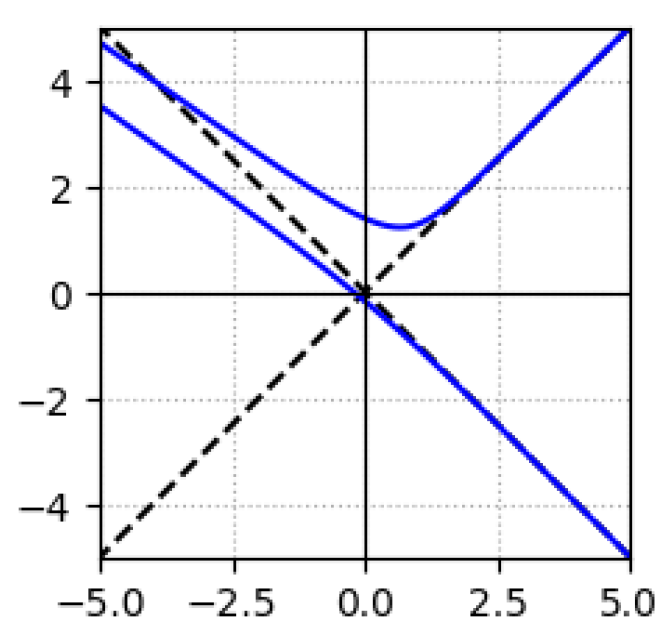
So now it remains to solve these differential equations, for cases $v = (1,0)$, $v = (0,1)$, $v = (1,1)$, each representing the cases of spacelike, timelike, and lightlike vectors. The paper will include a table of all possible solutions to the equations and the corresponding plots of the solutions. Here we give an example of one of the solutions.
3. Further remarks
Near the end of the research, I discussed with my supervisor about the connection between $\lambda$-translators in $\mathbb{R}^{n+1}$ and constant mean curvature surfaces, under Ilmanen's metric. [2] The paper will include a proof of this connection too.
This research is limited to the case $\mathbb{R}^{1,1}$, but it is possible to extend the results to higher-dimensional examples. This remains as further work to be done.
Update (July 2026): I am currently computing examples in $\mathbb{R}^{1,2}$ and $\mathbb{R}^{2,1}$, using the "tilting" technique. This will allow me to obtain an infinite family of $\lambda$-translators, based off the $\mathbb{R}^{1,1}$ examples.
References
- J. Pérez García, Translating solitons of the mean curvature flow, Ph.D. Thesis, Universidad de Granada, 2016.
- T. Ilmanen, Elliptic regularization and partial regularity for motion by mean curvature, Mem. Amer. Math. Soc. 108 (1994).
- R. López, Invariant surfaces in Euclidean space with a log-linear density, Advances in Mathematics 339 (2018), 285-309.