Fundamental theorem of covering spaces
For path-connected, locally path-connected spaces $X,Y$, map $p:Y\to X$ is called a covering map if for any $x\in X$, there exists an open neighborhood $U$ of $x$ such that $$p^{-1}(U) = \coprod_{\alpha\in A} V_\alpha,$$ a nonempty disjoint union of open sets and the restriction $p|_{V_\alpha}$ is a homeomorphism to $U$. For such $Y$, we call it the covering space of $X$.
Intuitively, we can imagine $Y$ as a space with disjoint replicas $V_\alpha$ of open neighborhoods $U\subset X$, which are also homeomorphic to $U$. So each point on $V_\alpha$ is sent to a distinct point on $U$. The number of these replicas is called the degree of the covering space, and the degree turns out to be equal for any open neighborhood in $X$ that satisfies the above property.
Covering spaces are important because they give a Galois correspondence as follows:
Sketch of Proof. Step 1. The first step to realising this correspondence is by observing that under the functor $\pi_1:\mathbf{Top}_*\to\mathbf{Group}$, the map $p_*:\pi_1(Y,y)\to \pi_1(X,x)$, corresponding to map $p$ under the functor $\pi_1$, is injective. Hence, $\pi_1(Y,y)\cong p_*\pi_1(Y,y)$ and $p_*\pi_1(Y,y)$ is a subgroup of $\pi_1(X,x)$.
Step 2. well-defined: isomorphism between two covers $p:(Y,y)\to (X,x)$ and $q:(Z,z)\to (X,x)$ gives a commutative diagram 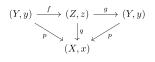 where $g\circ f = \mathrm{id}_Y$ and $f\circ g = \mathrm{id}_Z$. Hence, $g_*\circ f_* = \mathrm{id}_{\pi_1(Y,y)}$ and $f_*\circ g_* = \mathrm{id}_{\pi_1(Z,z)}$, giving an isomorphism between $\pi_1(Y,y)$ and $\pi_1(Z,z)$. Since $q\circ f = p$, we get $q_*\circ f_* = p_*$, and $f_*$ is an isomorphism, so $p_*\pi_1(Y,y) = q_*f_*\pi_1(Y,y) = q_*\pi_1(Z,z)$.
Step 3. Injectivity follows from the lifting criterion [1, Prop 1.33]: given covering map $p:(Y,y)\to (X,x)$, map $f:(Z,z)\to (X,x)$ has a unique lift $\widetilde{f}:(Z,z)\to (Y,y)$ iff $f_*\pi_1(Z,z)\subset p_*\pi_1(Y,y)$. So if $p_*\pi_1(Y,y) = q_*\pi_1(Z,z)$, we can find unique lifts $f,g$ of $q,p$, respectively, which become isomorphisms between the covering spaces.
Step 4. Surjectivity follows from deck transformations and universal covers. $\mathrm{Deck}(p:Y\to X)$ is a group of homeomorphisms $f:Y\to Y$ such that $p = p\circ f$. If its action on the fiber $p^{-1}(x)$ is transitive, we say that the cover is regular. A cover is regular iff $p_*\pi_1(Y,y)$ is a normal subgroup of $\pi_1(X,x)$, and we also have the identification $$\mathrm{Deck}(p)\cong\frac{N_{\pi_1(X,x)}p_*\pi_1(Y,y)}{p_*\pi_1(Y,y)}.$$ A universal cover is a cover that is simply connected. Consequently, it covers every other cover and is always regular since the trivial group is a normal subgroup in any group. Universal covers exist for semi-locally simply connected spaces, and the deck transformation of a universal cover is isomorphic to $\pi_1(X,x)$.
Combining these pieces, we can find a covering space that is mapped to some subgroup $G$ of $\pi_1(X,x)$. A universal cover $q:(\widetilde{X},\widetilde{x})\to (X,x)$ gives a group isomorphism $\varphi: \pi_1(X,x)\to \mathrm{Deck}(\widetilde{X})$, so we can define $H = \varphi(G)$ and $$Y = \widetilde{X}/H = \widetilde{X}/\{z\sim g(z): z\in\widetilde{X}, g\in H\}$$ with base point $y = [\widetilde{x}]$. We can claim that there is a map $p:(Y,y)\to (X,x)$ that is a covering map, and that $p_*\pi_1(Y,y) = G$, proving surjectivity. $\square$
References
- A. Hatcher, Algebraic topology, Cambridge University Press, 2002.
- S. Sivek, Algebraic topology, Lecture Notes, Imperial College London, 2026.